


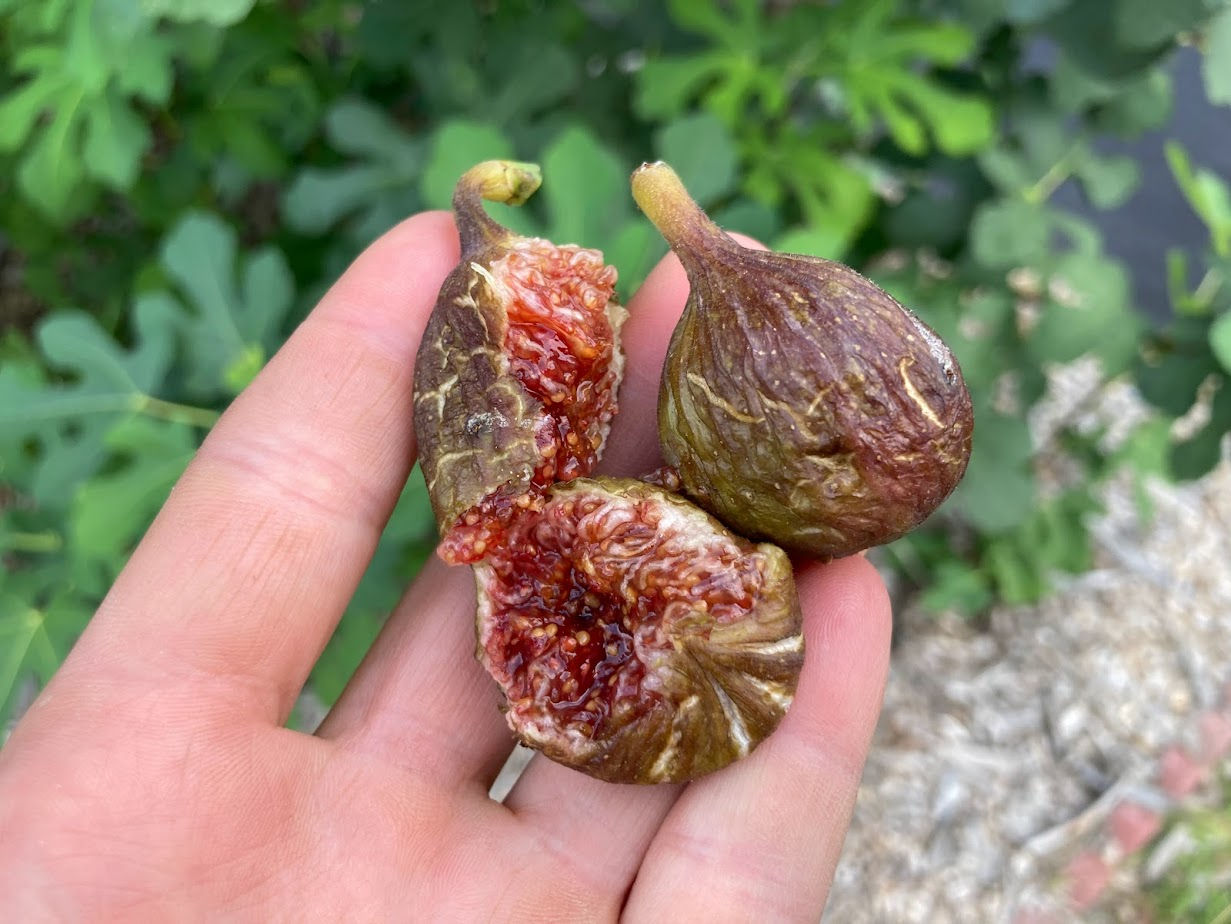

Teramo has become one of my favorite fig varieties. Not only for performance, but also for flavor. Its one downside is an unproven higher degree of hardiness. Teramo would make an excellent choice for anyone in a shorter or mild climate wanting the amazing eating experience that late varieties can provide. I consider it a must-grow in the PNW or places like the UK.
Teramo is an unknown fig tree BigBill from OffTheBeatenPath Nursery found growing at a home in Maryland that has a lineage tracing back to Teramo in Italy. At this home, he found a large tree planted in the ground, unprotected, with a very early ripening main crop.
Because of BigBill and others, Teramo has become a fairly widespread variety among collectors. Yet, I find that few of them appreciate Teramo for what it's really worth. In 2023 and 2024, it consistently produced some of the best figs I ate all year.
When BigBill visited my orchard in 2023, he was shocked to see firsthand how red the interior of my Teramo figs was. The truth is, they've been red for years, and every time they ripen, they're that color. As a result, a corresponding berry flavor is the dominant flavor profile that actually has some acidity, unlike most unpollinated figs. Teramo is not a sugar or honey fig. It has one of the strongest berry flavors of any fig I grow (rivaling some of the late varieties).
As for its growing characteristics, Teramo is extremely early, as BigBill originally discovered, ripening the main crop as early as possible. It also produces a light breba crop when the one-year-old wood can be preserved. I'd also categorize it as one of the best fig varieties for drying on the tree, among others like Nerucciolo d'Elba, Marseillaise, and Verdino del Nord.
Because of its extremely short hang time, they dry on the tree nearly every time here in my humid Philadelphia area climate. Combining its consistently high fruit quality with its strong berry flavor, its eating experience is top-tier, rivaling the eating qualities of Smith and Campaniere.
Unfortunately, the winter of 24-25 was not kind to my Teramo tree. It suffered major winter dieback. I was very surprised to see this, considering where BigBill originally found it. However, as I've discussed many times, just because one Teramo tree did not fare well during a bad winter, it doesn't mean it isn't hardy. In 2025, I planted a second tree for testing in a different location.
Over the years, similar varieties with different names have been introduced, like Nebo, Brandon St. Unk, and Brown Sugar Crunch. I believe all of these are synonyms.
)